
5 MIN READ·DECEMBER 1, 2025
How Systematic Trading Breaks the Emotion Loop
Most investors think their decisions are driven by research. In reality, their decisions are driven by emotion long before a single chart or data point is ever analyzed. You feel excitement, you feel hesitation, you feel pressure, and those feelings quietly sh
MR
CONTRIBUTOR · MARKET RADAR

Most investors think their decisions are driven by research. In reality, their decisions are driven by emotion long before a single chart or data point is ever analyzed. You feel excitement, you feel hesitation, you feel pressure, and those feelings quietly shape what information you look for and which conclusions you accept. What appears to be analysis is often just emotion searching for confirmation.
This is the central problem we work to solve. Markets move faster than human instincts can keep up with, and when volatility rises, even experienced traders fall into the same pattern of reacting instead of processing. The goal of this Ledger is to show why systematic trading offers a way out of that loop. It is the approach that consistently turns emotion into structure and transforms information into clear, repeatable decisions.
Before we break down how our RQF framework does this through regimes, trends, and strict execution, it helps to look at the environment we are operating in right now. Every decision begins with understanding the world as it is, not as we feel it should be.
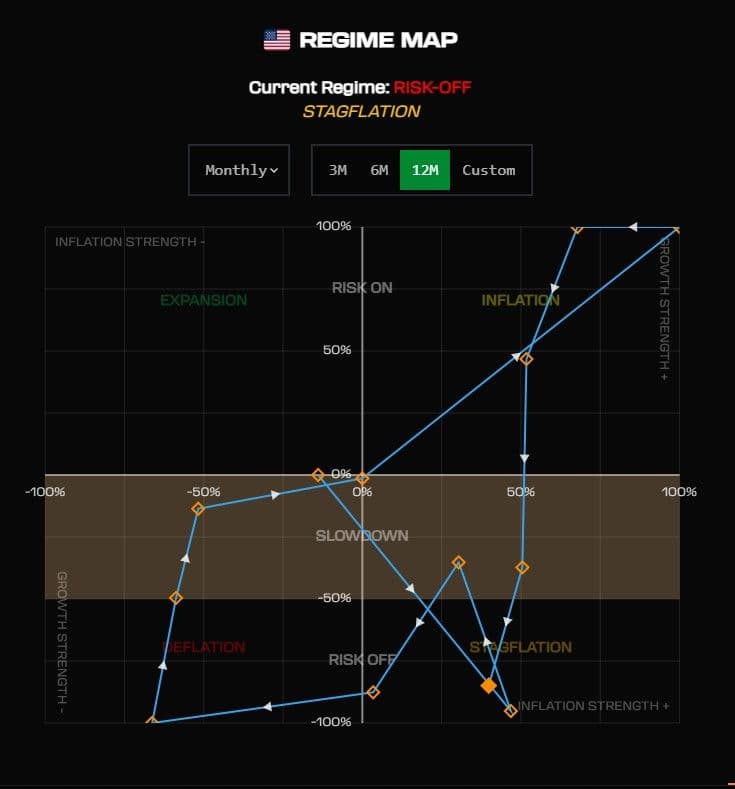
Our live Regime Map provides a real-time view of where the market stands within the growth and inflation cycle. It identifies the current regime: Risk-on, Slowdown, or Risk-off, and helps quantify the environment before any positioning decisions are made.
At the center of every investment decision lies a simple formula: Emotions + Information = Investment Thesis. How we feel about an idea drives where we focus our attention, and the information we gather shapes what we ultimately believe. Emotions determine the questions we ask, while information determines the answers we accept. When either is out of balance, the thesis weakens. Successful investing comes from understanding this relationship and building a process that manages both.
For most investors, every decision starts with a feeling. Something looks interesting, a story sounds convincing, or a chart seems ready to move. That feeling becomes the spark that drives research, analysis, and eventually conviction. Yet emotion is volatile. It grows strongest when prices rise and turns against us when they fall. It shapes what we pay attention to and what we choose to ignore. Without structure, information becomes filtered through emotion, and decision-making becomes inconsistent.
Information should bring balance. It should help transform instinct into insight. But in markets that move faster than ever, information can just as easily create confusion. Two people can see the same data and reach entirely different conclusions. It is not the information itself that determines success but how it is processed and applied. When the flow of information becomes overwhelming, emotion takes over again, and discipline fades.
This is the problem systematic trading is designed to solve. A system provides the structure that keeps emotion and information in balance. Rather than letting feelings interpret data, a system processes information objectively and turns it into clear, rules-based action.
Our RQF framework was built around this concept. It blends two specialized systems, Ares and Astraeus, into one unified process. Ares focuses on traditional assets such as stocks and bonds, while Astraeus captures alternative risk exposure through bitcoin and digital assets. Together, they form a complete view of market dynamics that can adapt to different environments. The goal is not prediction but structure. RQF isolates the emotional elements of decision-making and replaces them with data-driven logic that can be repeated, tested, and refined over time.
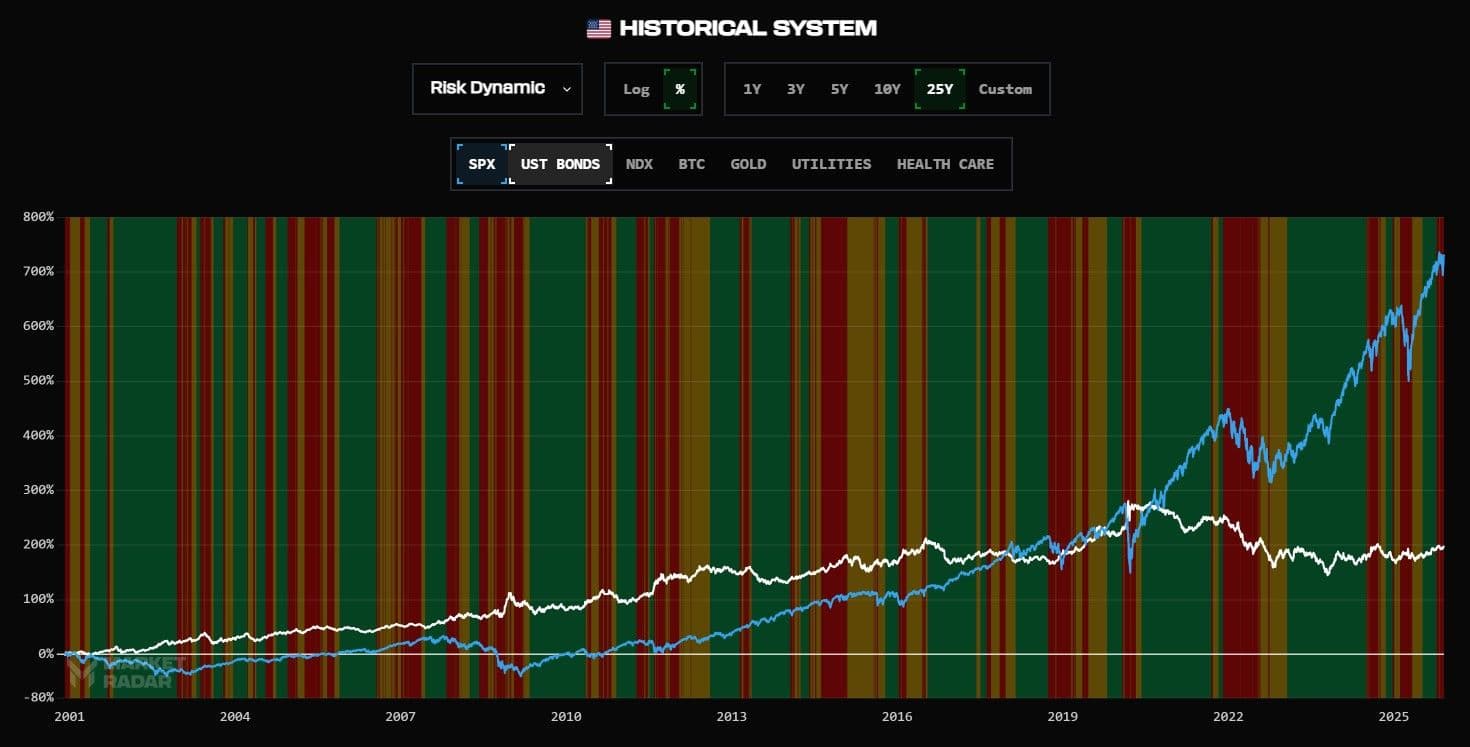
The historical regime model visualizes how the system identifies and classifies market environments into risk-on (green), slowdown (orange), and risk-off (red) conditions over time.
🚀 Join the Radar Community
Get free access to MacroBase and notifications about new posts and updates.
At the core of RQF is our regime model, which defines the market environment as either risk-on, slowdown, or risk-off. These regimes act as the informational foundation of every position. Green represents risk-on periods when growth assets tend to outperform. Orange signals a slowdown, where defensive allocation begins to matter more. Red marks risk-off conditions, when preservation of capital takes priority. By isolating the market into these three regimes, we can contextualize the flow of information and convert it into structured positioning rather than emotional reaction.
The regime model functions as our compass. It identifies where the market stands in its cycle, which allows us to allocate risk appropriately before making tactical adjustments. From there, individual asset trends provide confirmation. When trends align with the regime backdrop, conviction is there for positions. When they diverge, exposure is cut. This layered approach transforms information into a clear thesis. The result is positioning that is logical, measurable, and repeatable.
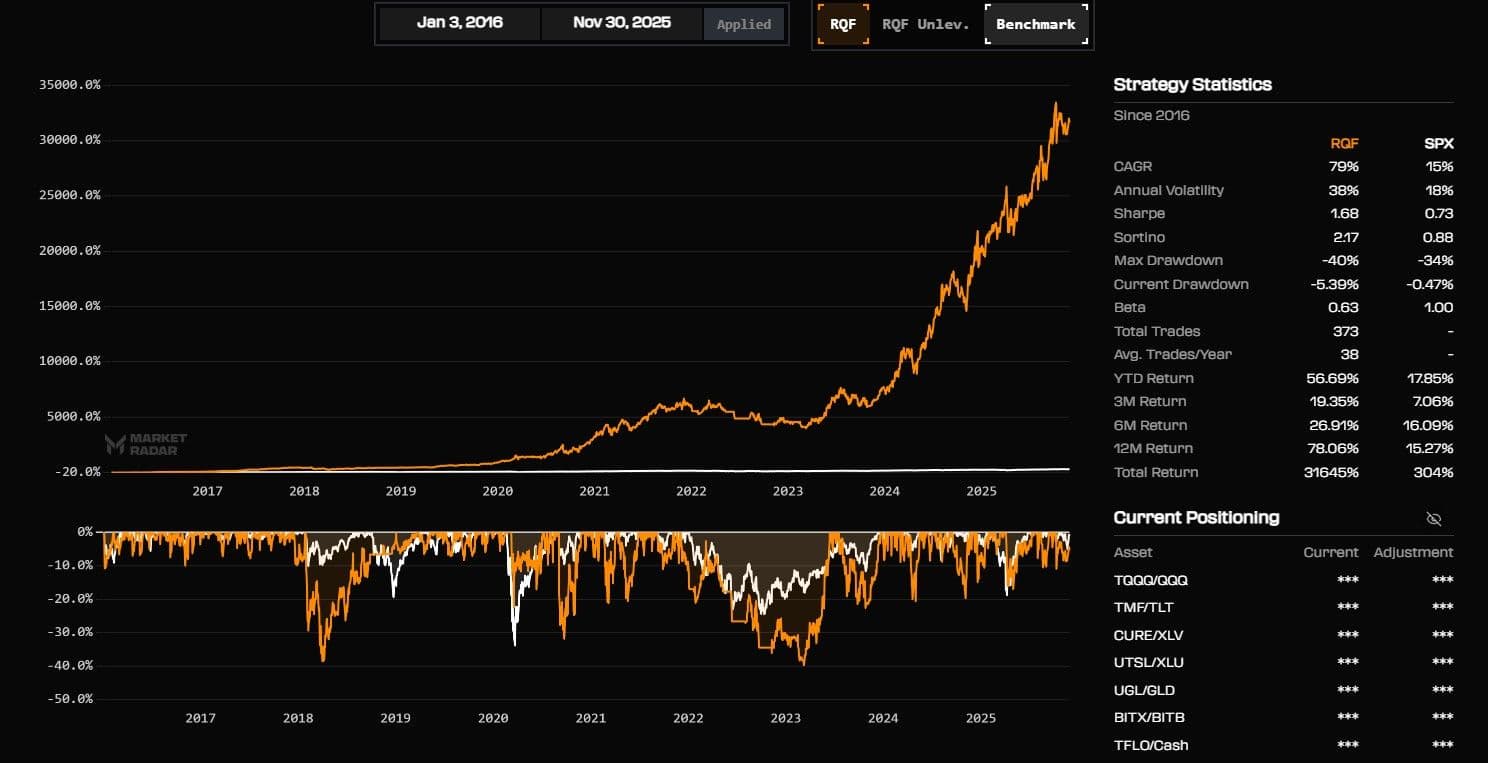
The performance history of RQF compared to the S&P 500 highlights the power of regime-based decision-making and systematic execution.
The long-term data behind this approach speaks to its consistency. Since 2016, RQF has produced a compound annual growth rate of roughly 79 percent compared to 15 percent for the S&P 500, with a maximum drawdown of 40 percent versus 34 percent for the benchmark. The strategy’s Sharpe and Sortino ratios reflect both higher efficiency and better downside protection. Even when volatility rises, the system maintains structure. It reacts to the same variables that drive fear in others but does so without emotion.
The power of a systematic framework lies in its ability to transform uncertainty into structure. Markets will always shift between optimism and fear, but by mapping those shifts through identifiable regimes, the system can adapt rather than react. Ares and Astraeus operate as the engines within RQF, each contributing unique perspectives from their asset classes while remaining unified by the same discipline.
The real advantage, however, is psychological. Systematic trading gives us something that human instinct cannot: clarity during chaos. When volatility spikes or narratives change, the framework does not panic. It adjusts positioning based on data and predefined thresholds. It turns the constant emotional noise of markets into quantifiable signals.
This structure also reinforces two of the hardest skills in trading: emotional control and consistent execution. By following a repeatable process rooted in data, we avoid the most common behavioral pitfalls and strengthen our confidence in the system over time. The framework does not remove the human element but manages it, allowing the system to do what emotions cannot: stay patient, disciplined, and aligned with probabilities rather than opinions.
Our long-term philosophy remains the same: survive first, then compound. A systematic strategy is not built to make anyone rich overnight. It is built to survive cycles, protecting capital when risk rises and expanding exposure when the environment turns favorable. The key is discipline. Rules are sacred. Once broken, the historical validity of every test, return, and statistic disappears.
Systematic trading is not about predicting every move. It is about positioning intelligently for every regime. By grounding decisions in structure rather than emotion, we can see the market more clearly, adapt more efficiently, and compound more effectively. The result is not perfection, but consistency, and consistency, protected by structure, is what builds lasting success.
Want to know how we’re positioning before the next market shift? Subscribe below to get real-time access to our models, signals, and strategy updates. Below the paywall, you can get real-time positioning and regime outputs updated daily on QuantBase.
MOST POPULAR
Unlock Premium Content
The remainder of this content is available to Radar members only. Subscribe to gain instant access.
$65/month
Billed annually at $780 (Save $120)
Access Models which boast 40%+ average yearly returns
Automated Portfolio Signals (RQF Strategy)
Live Calls with experienced traders
QuantBase Dashboard with macro regime models
DDAP TradingView Indicator
Real-time portfolio updates
Private Discord Channels
Lifetime Price Lock|Instant Access